
Dynamic Weigh-Price Labeling Automation: Architectural Analysis of the CF-W01P Print and Apply System
In automated fresh food packaging, logistics fulfillment, and industrial inventory management, processing variable-weight items presents a distinct operational hurdle. Products such as catch-weight meats, fresh produce trays, cheeses, and shipping parcels cannot utilize standard pre-printed labels because each package possesses a unique mass that dictates its final pricing, barcode data, and inventory metrics. Separating the checkweighing process from the print-and-apply station introduces line footprint inefficiencies, synchronization risks, and database lagging.
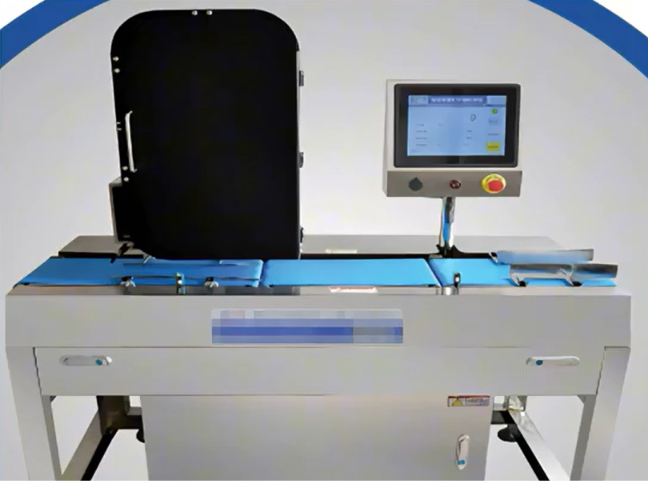
The CF-W01P Intelligent Weighing Printing and Labeling Machine addresses these multi-variable requirements by embedding a high-speed dynamic strain-gauge load cell directly into an automated servo-driven labeling line. This layout calculates package weight on the fly, instantly cross-references pricing or inventory databases, prints a custom thermal transfer label, and applies it to the moving substrate within a single, space-saving conveyor bed.
Multi-Stage Conveyor Architecture and Dynamic Weighing Physics
To calculate an accurate mass measurement while a product is moving, a machine must isolate the substrate from external vibration and mechanical noise. The CF-W01P accomplishes this by dividing its conveyor path into three structurally isolated motor zones.
The Three-Zone Belt Array
- Infeed & Spacing Conveyor: This intake belt accepts incoming packages from upstream wrapping or sealing systems. It accelerates or decelerates items dynamically to ensure a uniform gap exists between individual pieces before they advance.
- Dynamic Weighing Table: The central conveyor bed is mounted directly to an industrial strain-gauge load cell and completely isolated from the main machine frame. As a package passes over this belt, its downward force alters the electrical resistance of the load cell. The internal controller samples these voltage changes hundreds of times per second, filtering out motor harmonics to determine the exact weight without stopping the line.
- Outfeed & Labeling Zone: Once weighed, the item transitions onto the final application conveyor belt, where it is stabilized under guide rails for label placement.
Real-Time Data Pipeline and Print-Head Execution
The core electronic value of the CF-W01P relies on its high-speed processing loop. The time elapsed between a package crossing the weighing table and entering the labeling zone is often less than a second, requiring rapid information management.
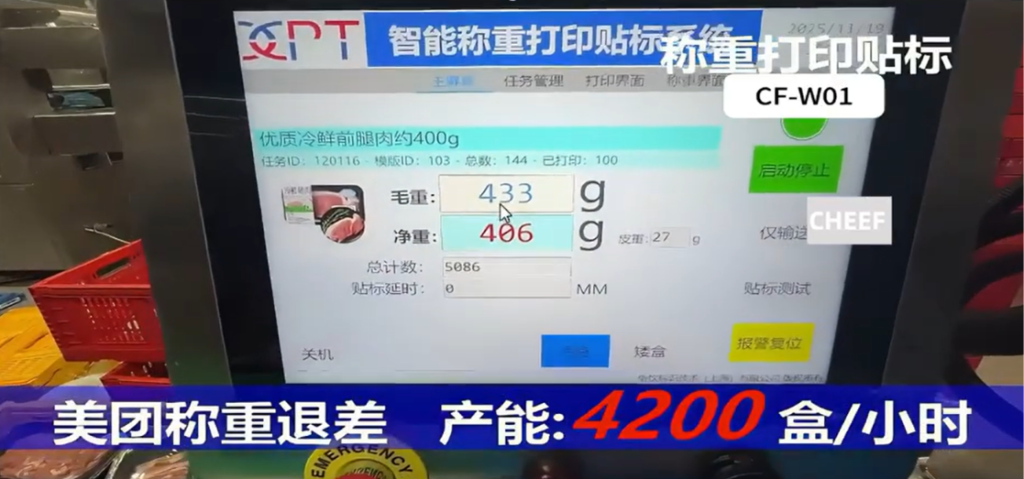
- Instantaneous Data Compilation: The moment a package clears the weighing table, the load cell processor transmits the mass value to the central PLC. The system immediately calculates the final price (mass multiplied by the SKU price rate) and updates the variable data elements, including custom data matrices, standard barcodes, exact weights, and packaging timestamps.
- Inline Thermal Printing: The compiled text file is sent to an industrial digital print head positioned over the outfeed conveyor. The print head activates its localized heating elements to transfer the variable data onto blank label stock moving through the web path.
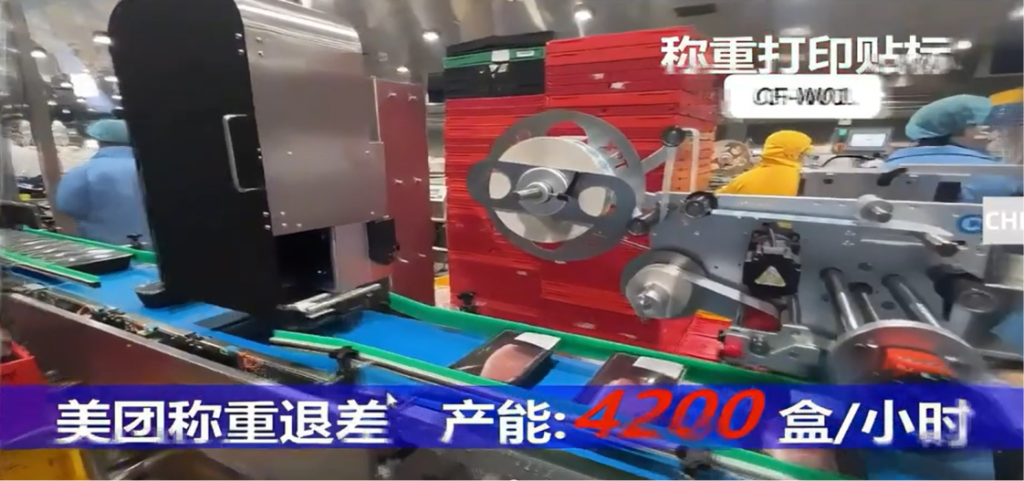
- Synchronized Servo Application: A high-precision electrical servo motor drives the label roll feed, pushing the completed label across a steel peel blade to meet the moving package. Optional application mechanisms—such as soft rubber rollers, air-blow nozzles, or telescoping tamp pads—can be swapped in depending on whether the target surface is a rigid carton or a delicate food film.
Hardware Profiles and System Specifications
The CF-W01P platform features a rugged, washdown-tolerant design optimized for modern, high-throughput packaging environments:
- Electrical Infrastructure: Engineered to run on standard 220V AC single-phase lines (50/60 Hz), allowing easy deployment into standard industrial facility grids.
- Weighing Accuracy Threshold: The dynamic load cell balances speed with precision, offering an accuracy resolution within plus or minus 0.5 to 2 grams depending on total item mass and conveyor velocity.
- Placement Window Precision: High-torque electrical servo drives manage web tracking and dispensing speeds, keeping final label placement tolerances within a tight plus or minus 1.0 mm window.
- Modular Print Formats: Features interchangeable print engines available in three standard widths—32mm, 53mm, and a wide-format 107mm footprint—to accommodate anything from small pricing stickers to large logistics barcodes.
- Variable Production Output: Supports variable conveyor speeds up to 45 meters per minute, allowing the platform to process between 40 and 120 catch-weight packages per minute depending on product size.
Primary Industrial Applications
The integration of on-the-fly checkweighing and online printing makes the CF-W01P highly valuable across several primary packaging sectors:
- Fresh Meat, Poultry, and Seafood Packaging: Automatically weighs wrapped meat trays, vacuum-sealed fish fillets, or poultry packs. The system calculates the exact price per pack, updates the scannable barcode, and applies the finished label cleanly to the upper sealing film.
- Logistics and E-Commerce Distribution: Used as an inline shipping weight compliance station. The machine weighs packed boxes, compares the reading against billing manifests to prevent shipping fraud, and prints the final customer routing and postage label in one pass.
- Agricultural Produce Packing: Speeds up operations by processing varied bags or clam-shells of fruits, vegetables, and nuts. It prints and applies regional compliance data, harvest source tracking codes, and variable weights onto the container exterior.
Field Tuning, Calibration, and Preventative Maintenance
To maintain legal-for-trade weighing accuracy and seamless label application across multi-shift continuous production schedules, plant teams must follow a regular calibration program.
Component Cleaning and Protection
- Load Cell Protection: The central weighing table must be kept clear of physical debris, product spills, or grease buildup. If dust or product fragments lodge beneath the floating scale conveyor bed, they will create a mechanical bypass that dampens scale movement, resulting in inaccurate weight readings.
- Print Head Maintenance: Ribbon dust and adhesive residue gather along the edge of the digital thermal head during operation. Technicians should wipe down the heating elements using lint-free swabs and 99% electronic-grade isopropyl alcohol at every ribbon roll changeover to protect print clarity and prevent element burnouts.
Field Tuning Protocols
- Dynamic Scale Calibration: Environmental vibrations from neighboring machinery can introduce noise into scale readings. Maintenance teams should use certified test weights weekly to calibrate the scale, and adjust the digital filtering algorithms via the touchscreen Human-Machine Interface (HMI) to filter out plant floor vibrations.
- Application Speed Balancing: If labels exhibit wrinkles or edge lifting, check the conveyor velocity matching parameters in the software. The label dispensing drive must match the speed of the outfeed conveyor belt exactly to prevent the label from stretching or bunching up as it contacts the container.
System Advantages
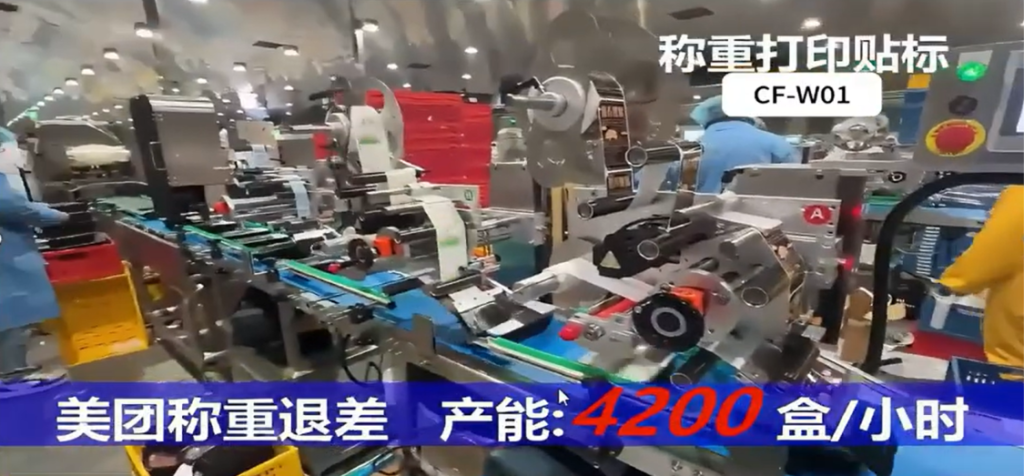
- All-in-One Weigh-Print-Apply: Combines checkweighing, variable data rendering, and label application into a single compact machine, reducing required line length.
- High-Accuracy Load Cell: Features an industrial strain-gauge weighing system that delivers reliable weight readings down to gram-level accuracy while lines move at full speed.
- Instant Variable Serialization: A high-speed PLC processor generates custom text, barcodes, and pricing charts on the fly for every single package, eliminating data lag.
- Flexible Application Formats: Supports multiple interchangeable application styles (roll-on, air-blow, or tamp) to handle everything from rigid boxes to fragile, flexible food trays.
Frequently Asked Questions (FAQ)
Q1: Can the CF-W01P automatically reject packages that fall outside of predefined weight limits?
Yes. The central PLC software features integrated underweight and overweight threshold settings. If a package crosses the scale and its mass registers below or above your configured parameters, the machine can trigger a downstream pneumatic push-rod, air-blast nozzle, or diverter gate to automatically remove the out-of-spec product from the primary packaging line without stopping production.
Q2: What happens if moisture or water drops onto the weighing conveyor in fresh food environments?
The CF-W01P is built with stainless steel framing and features moisture-protected load cell enclosures suitable for food packing facilities. However, standing water on the scale belt can register as tare weight and skew your readings. The system should be integrated into a draft shield hood to prevent air currents or dripping water from affecting the scale, and the belt should be wiped down during scheduled line breaks.
Q3: How does the system handle pricing updates when changing production runs for different SKUs?
All product profiles, weight-to-cost ratios, and barcode structures are stored as digital SKUs within the machine’s onboard touchscreen HMI memory. When switching production runs—for instance, from ground beef trays to ribeye steaks—the operator simply selects the new product profile on the screen. The machine instantly loads the updated pricing matrix and label layout configuration with no mechanical changes required.
Q4: Why is an electrical servo motor preferred over a stepper motor for driving the label feed in this system?
Stepper motors operate using fixed digital steps and can lose synchronization or slip if web resistance changes suddenly at high speeds, which causes printing shifts or label tracking errors. An electrical servo motor uses continuous encoder feedback to monitor its exact rotational position in real time. This design allows it to automatically correct for tension variations, deliver smoother acceleration profiles, and maintain a strict plus or minus 1.0 mm application tolerance during high-speed runs.
Watch the Full Video Tutorial:
This article summarizes the key points from our original video. Watching the full tutorial provides a clearer understanding of the procedures, demonstrations, and practical maintenance tips.
▶ Watch the full video below.
📺 Subscribe to the Cheef YouTube Channel to receive future maintenance guides, troubleshooting tutorials, product demonstrations, and industry updates.
