
Maximizing Packaging Line Uptime: The Engineering Blueprint to Videojet’s SIMPLICITY™ CIJ Fleet
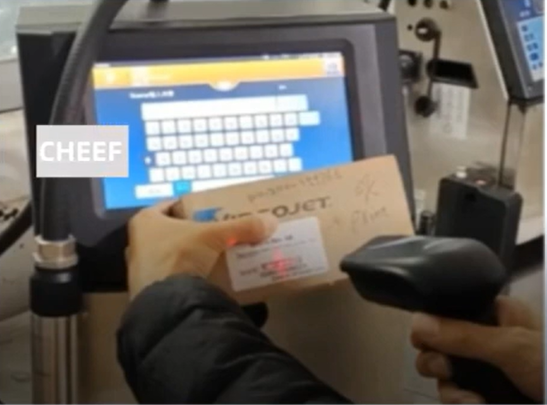
For plant managers, packaging engineers, and maintenance supervisors, industrial coding isn’t just about printing expiration dates—it’s about protecting line throughput. A single unscheduled printer stoppage can halt an entire packaging line, backing up upstream production and costing thousands of dollars per hour.
With its SIMPLICITY™ continuous inkjet (CIJ) lineup, Videojet redesigned the industrial printer from the operator’s perspective. By matching advanced fluid dynamics with predictive, automated maintenance tools, these systems aim to eliminate the common pain points of traditional industrial printing.
This engineering guide breaks down the core functional architecture, fluid loops, and hardware options across the SIMPLICITY™ fleet (including the 1240, 1280, 1580, 1580 Plus, and 1880 series) to help you choose the right system for your production environment.
The Hardware Architecture: Built for the Factory Floor
A continuous inkjet printer is only as reliable as its physical design. The SIMPLICITY™ series introduces several mechanical updates engineered to withstand harsh factory environments.
1. Environmental Ingress Protection (IP) & 316 Stainless Steel
Industrial environments vary wildly, from clean, dry pharmaceutical lines to high-pressure washdown environments in dairy and beverage plants. Because these conditions demand different levels of protection, housing ratings must be configured at the factory before shipment:
- Videojet 1240 & 1280: Built to standard IP55 specifications, ideal for standard cartoning, light manufacturing, and dry packaging lines.
- Videojet 1580: Offers a choice between IP55 and IP65 structural frames depending on your facility’s washdown protocols.
- Videojet 1880: Available in IP55 or heavy-duty IP66 configurations. The IP66 version is constructed from premium 316-grade stainless steel, providing excellent protection against corrosive chemical washdowns, high humidity, and salt spray.
2. Positive Air Pressure Without Factory Air Lines
Airborne dust, flour, fiber, and moisture can drift between a printhead’s high-voltage deflection plates, causing electrical short-circuits and line faults. To prevent this, the SIMPLICITY™ series (except the baseline 1240) features an optional internal positive-pressure pump.
This system generates its own clean, continuous outbound airflow to keep airborne debris out of the printhead nozzle assembly—without needing a separate, dry factory compressed air line.
3. Kinematics: Rotatable 90° Heads and Armored Conduits
Mounting a printhead over a crowded, complex packaging conveyor often requires tight angles.
- The 1880 Plus Rotatable Head: While standard models feature fixed printhead angles, the 1880 Plus introduces a 90-degree head assembly that can rotate up to 45 degrees relative to the conduit. This gives installation teams the flexibility to mount the printhead in tight spaces without kinking internal lines.
- Armored Flexible Conduits: If your line uses traversing mechanisms to move the printhead back and forth across wide webs or multi-lane trays, standard conduits can quickly wear out or crack. Videojet offers a heavy-duty 6-meter armored flexible conduit designed to protect internal fluid lines from continuous mechanical motion.
Intelligent Fluid Loops and 20% Solvent Savings
Historically, CIJ printers have been notorious for high solvent evaporation rates and messy manual fluid refills. The SIMPLICITY™ fluid loop directly addresses these operational costs.
[Sealed Cartridge Inserted] ──► [Needle-and-Film Piercing] ──► [Zero Solvent Vapor Leaks]
│
▼
[Total Fluid Draw] ◄── [Reservoir Bag Collapses Flat] ◄── [Negative-Pressure Suction]
- Sealed Needle-and-Film Intakes: Operators no longer need to pour raw ink or solvent into open reservoirs. The SIMPLICITY™ cartridges feature a sealed film layer that is punctured by an internal needle socket only when fully inserted, containing harmful solvent fumes and preventing workplace spills.
- Negative-Pressure Suction: Rather than relying on simple gravity feed, the fluid system uses a regulated vacuum loop to pull fluids into the mixing tank. This negative pressure collapses the inner cartridge lining completely flat, extracting every last drop of consumable fluid and eliminating chemical waste.
- RFID Mistake-Proofing: Integrated RFID readers scan each cartridge chip upon insertion to verify chemical compatibility, ensuring operators never accidentally mix incompatible ink and solvent formulations.
- 20% Solvent Recovery Condenser: Active continuous ink loops naturally generate solvent vapor. To reduce chemical consumption, these printers include an integrated solvent condensation system that captures gas-phase vapors from the return lines and re-liquefies them back into the active mixing tank, cutting makeup solvent consumption by up to 20%.
Eliminating Human Error via Advanced Software
Even the most reliable hardware can be undercut by human error during message selection or fluid replenishment. The SIMPLICITY™ interface uses targeted software features to keep production moving smoothly.
The GFK Eye-Tracking Interface
Partnering with the global research firm GFK, Videojet designed its user interface around real-world operator tablet habits and eye-movement data. The resulting large-screen control interface uses oversized icons, intuitive wizard guides, and restricted menu access to reduce operator errors by up to 70%.
Predictive Refill Analytics
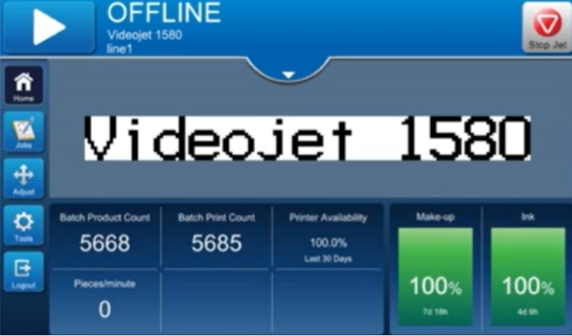
Rather than relying on vague low-fluid warnings, the 1580 Plus and 1880 series monitor real-time print density, ambient temperatures, and production volume to provide a live “days-of-use” countdown for ink and solvent cartridges. This visibility allows inventory and maintenance teams to schedule fluid changes during planned line changeovers rather than scrambling during a live production run.
Integrated Maintenance Videos
When a line operator needs to clear a nozzle or replace a component, they don’t have to search through a paper manual. Step-by-step instructional videos play directly on the printer’s touchscreen interface, guiding operators through standard maintenance tasks and reducing errors caused by staff turnover.

Advanced Uptime Engineering: The 1880 Diagnostic Suite
For high-speed, continuous production operations, the Videojet 1880 series includes a specialized hardware diagnostic suite that targets the root cause of most inkjet print issues.
Return Gutter Ink Accumulation Sensor
Statistically, over 70% of continuous inkjet print issues are caused by ink gradually building up inside the vacuum return gutter. Micro-splatters build up over time, eventually clipping the flying ink droplets and causing blurred or missing text codes.
The 1880 series addresses this issue with an industry-first optoelectronic sensor mounted directly inside the return gutter opening. This sensor monitors residue buildup in real time and alerts operators on the main display screen before the buildup distorts code quality or triggers a line fault.
One-Click Micro-Solvent Wash Loop
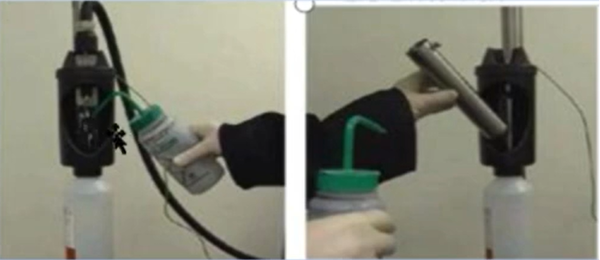
When the gutter sensor flags an alert, operators don’t need to open the printhead cabinet and manually clean it with external wash bottles. Instead, they can trigger the one-click automated self-cleaning cycle from the touchscreen.
The printer isolates the primary ink line and pumps exactly 2 mL of clean makeup solvent directly through the return gutter assembly. This quickly dissolves ink residue using internal fluid lines, reducing solvent waste and preventing secondary printhead contamination.
Frequently Asked Questions (FAQ)
What is the primary difference between High-Performance and Entry-Level Videojet CIJ models?
High-performance models (such as the 1880 series) feature advanced predictive maintenance sensors, higher print speeds, and advanced diagnostic suites like return gutter accumulation tracking. Entry-level models (like the 1240 and 1280) focus on reliable baseline coding for lower-speed lines, utilizing simplified, all-in-one modular service blocks to keep maintenance straightforward.
How does the 20% solvent condensing system save money?
During standard operation, volatile solvent fluids evaporate into gas as the ink drops travel through the air. Videojet’s integrated condenser captures these solvent vapors from the return vacuum line, chills them back into liquid form, and routes them back into the active mixing tank. This process reduces the volume of new makeup solvent your facility needs to purchase by up to 20%.
Can I upgrade my printer’s IP protection rating in the field if our washdown protocols change?
No. Structural ingress protection ratings (such as IP55, IP65, and IP66) require specific cabinet components, chassis seals, and venting designs that must be assembled at the factory. These configurations cannot be modified in the field, so it is important to verify your production line’s washdown requirements with your sales and engineering team before ordering.
What happens when the SmartCell™ service module reaches its hour limit?
When the internal runtime counter for your color-coded SmartCell™ module expires (typically at 3,000, 5,000, or 8,000 hours depending on the model), the printer triggers a 150-hour or 15-day grace period buffer. This buffer gives your maintenance team plenty of time to schedule a replacement during standard planned downtime before the system locks out to protect its internal hydraulics.
When is an armored conduit required instead of a standard 3-meter throat?
A standard 3-meter throat is designed for stationary installations where the printhead is locked into a fixed bracket over the conveyor line. An armored flexible conduit (typically 6 meters) is required for mobile printhead applications, such as traversing mechanisms that move the printhead back and forth across wide webs or multi-lane packaging trays. The heavy-duty armored sleeve protects internal fluid lines from mechanical wear and kinking caused by continuous motion.
Watch the Full Video Tutorial:
This article summarizes the key points from our original video. Watching the full tutorial provides a clearer understanding of the procedures, demonstrations, and practical maintenance tips.
▶ Watch the full video below.
📺 Subscribe to the Cheef YouTube Channel to receive future maintenance guides, troubleshooting tutorials, product demonstrations, and industry updates.
