
Maximizing Throughput with the CF-DP01 Intelligent Dual-Head Print & Apply Labeling Machine
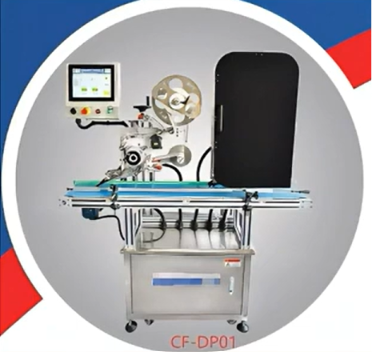
In high-volume packaging lines, labeling bottlenecks frequently undermine upstream production efficiency. Traditional setups that rely on separate systems for applying pre-printed branding and printing real-time variable data (such as batch codes, expiration dates, and shipping info) increase line footprint, labor costs, and the risk of synchronization errors.
The CF-DP01 Intelligent Dual-Head Real-Time Print & Apply Labeling Machine directly addresses these operational pain points. By combining an inline high-speed label applicator with a thermal transfer real-time print-and-apply engine on a single synchronized conveyor chassis, this system allows production facilities to execute multi-labeling requirements in a single pass.
Technical Architecture & Dual-Head Synchronization
The core engineering advantage of the CF-DP01 is its modular, dual-head design operating under a unified control architecture. Rather than routing products through multiple standalone machines, the system integrates two distinct operational heads along a centralized conveyor line.
[Product Input] —> [Head 1: Pre-Printed Applicator] —> [Head 2: Real-Time Print & Apply] —> [Output]
Head 1: High-Speed Pre-Printed Label Application
The first station is engineered exclusively for applying highly finished pre-printed labels—such as primary brand logos, promotional graphics, or regulatory compliance labels. Because it does not require an inline printing cycle, it can handle rapid dispensing sequences without introducing cycle-time latency.
Head 2: Dynamic Print-and-Apply Engine
The secondary station features an integrated thermal transfer and direct thermal printing system. Operating on an on-demand, synchronized signal, this head prints real-time variable data (including serialization, production dates, and batch codes) directly onto the label media immediately before dispensing and applying it to the substrate.
Full Servo Control System
Maintaining physical separation and exact label placement between these two processes requires precise timing. The CF-DP01 utilizes full closed-loop servo motors to drive both the conveyor feed and label dispensing axes. Unlike asynchronous AC motors or open-loop stepper systems, servo control provides continuous torque monitoring and position feedback. This ensures that even during rapid acceleration or deceleration cycles, the label application position remains entirely uniform.
Technical Specifications
| Parameter | Specification | Operational Relevance |
| Labeling Speed | 0 to 45 meters per minute | Adjustable to match upstream packing or filling machinery throughput. |
| Labeling Accuracy | $\pm$ 1.0 mm | Tight tolerance prevents skewed labels or placement drift on compact packaging surfaces. |
| Label Length Range | 10 mm to 300 mm | Accommodates small component trace labels up to wide shipping/pallet indicators. |
| Label Height Options | 100 mm / 150 mm variants | Standard configurations designed to cover typical industrial packaging dimensions. |
| Max Outer Diameter (Roll) | 300 mm | Minimizes roll-change downtime during continuous production shifts. |
| Core Inner Diameter | 75 mm to 76 mm | Industry-standard sizing compatible with major commercial label stock suppliers. |
| Power Supply / Consump. | 220V (50/60Hz) / 1.0 kW | Low energy footprint, easily integrated into standard plant electrical drop lines. |
| Total System Weight | 85 kg | Solid, low-vibration construction that preserves calibration over extended runtimes. |
Industrial Applications & Substrate Compatibility
The CF-DP01 is optimized for automated processing lines handling products with relatively flat or uniform surfaces.
- Pouch Packaged Fresh Foods: Ideal for bakery products and ready-to-eat meals where the first head applies the vibrant brand graphics, and the second applies the dynamic print-on-demand expiration date and ingredient weight corrections.
- Chemical & Paint Pails: Suitable for high-density polyethylene (HDPE) containers or metal cans with flat sides or lids, handling batch tracking codes alongside primary product data.
- FMCG Box & Carton Packaging: Fits seamlessly into secondary packaging lines for fast-moving consumer goods (FMCG), combining branding labels and variable shipping codes in a single station.
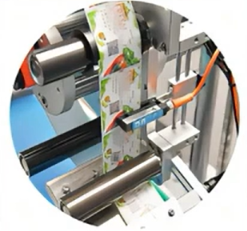
Maintenance Protocols & Troubleshooting Guide
To maximize equipment effectiveness (OEE) and prevent unplanned downtime, maintenance teams should adhere to a structured inspection routine.
Preventative Maintenance Checklist
- Daily Cleaning of the Printhead: Use an isopropyl alcohol (99%) swab to wipe down the thermal printhead elements on Head 2. This removes residual ribbon wax and paper dust, protecting print density and protecting the heating elements from premature failure.
- Sensors and Photoelectric Eye Alignment: Dust or debris on the label-gap sensor will cause label misfeeds or continuous unspooling. Clean the optical sensors daily with dry compressed air.
- Drive Roller Inspection: Ensure the rubber drive rollers are clear of adhesive buildup. Adhesive accumulation alters the friction coefficient, which directly degrades the machine’s $\pm 1.0\text{ mm}$ placement accuracy.
Troubleshooting Common Operational Anomalies
- Issue: Tracking Drift or Label Skewing
- Root Cause: Uneven tension on the unwind mandrel or improper positioning of the physical media guides.
- Correction: Re-seat the label roll tightly against the inner retaining plate. Verify that the 75–76 mm core inner diameter is securely locked by the mechanical mandrel adapters.
- Issue: Faint or Incomplete Variable Print on Head 2
- Root Cause: Incorrect dark/burn settings in the print controller or insufficient pressure across the printhead mechanism.
- Correction: Incrementally adjust the thermal transfer soft/hard coding agent temperature via the controller UI. Ensure the ribbon and label material types match (e.g., wax ribbons paired with paper stock, or resin ribbons with synthetic substrates).
- Issue: Occasional Missed Labels (Intermittent Skipping)
- Root Cause: The label gap sensor threshold is set incorrectly, causing it to miss the 3 mm gap between labels on the liner backing.
- Correction: recalibrate the photoelectric sensor on the current label media liner to ensure a clear distinction between the label backing and the leading edge of the next label.
Integration Benefits for Distributors and Plant Managers
Investing in a integrated dual-head layout like the CF-DP01 offers clear advantages over running multiple individual labeling systems:
- Reduced Total Footprint: With a compact main unit footprint and conveyor options ranging from 1.5 meters to 11.8 meters, this unit occupies significantly less physical space than two discrete labeling machines separated by buffers.
- Unified Control System: Operating a single panel reduces operator training requirements and streamlines production changeovers. Adjusting conveyor speed (up to 45 m/min) automatically scales the feed rates for both label heads synchronously.
- Lower Initial Capital Expenditure (CAPEX): Distributors can present end-users with a unified system that cuts down on required framing, additional line-integration wiring, and redundant sensor kits, lowering the overall cost of ownership.
Frequently Asked Questions (FAQ)
1. Can the machine operate with only one head if production needs change?
Yes. The control architecture allows each head to be enabled or disabled independently via the touchscreen interface. If a production batch only requires pre-printed brand labeling, Head 2 can be placed in standby mode without affecting the operation of Head 1.
2. What types of ribbon coding styles are supported?
The print engine supports both thermal transfer and direct thermal printing profiles. It is compatible with wax, wax-resin, and full-resin ribbons, giving you the flexibility to choose the right durability and cost structure for your specific application.
3. How does the machine handle variations in product thickness?
The applicator assemblies are mounted on adjustable columns with integrated mechanical position readouts. When switching between different packaging sizes (within the 10–300 mm length window), operators can quickly adjust the height and lock it in place to maintain the correct dispensing distance.
4. What is the importance of the 3 mm label gap specification?
The automated optical sensor array is calibrated around an industry-standard 3 mm gap between die-cut labels on the roll. Sticking to this spacing ensures clean edge detection and precise, repeatable label placement at speeds up to 45 meters per minute.
Watch the Full Video Tutorial:
This article summarizes the key points from our original video. Watching the full tutorial provides a clearer understanding of the procedures, demonstrations, and practical maintenance tips.
▶ Watch the full video below.
📺 Subscribe to the Cheef YouTube Channel to receive future maintenance guides, troubleshooting tutorials, product demonstrations, and industry updates.
