
Optimizing Composite Packaging Lines with the CF-DT01P Intelligent Multi-Head Print & Apply Machine
High-throughput industrial packaging setups often require multi-zone labeling. A typical pharmaceutical carton, medical kit, or daily chemical pouch might require a vibrant, high-resolution primary brand logo, a promotional or warning graphic, and critical variable regulatory data—such as sequential serialization, track-and-trace 2D barcodes, and manufacturing date codes.
Executing these diverse requirements usually involves a complex chain of standalone labeling stations. This traditional method increases total line footprint, creates product spacing bottlenecks, and makes unified synchronization difficult.
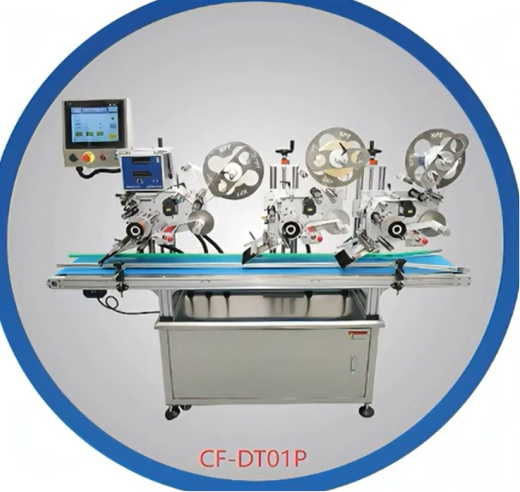
The CF-DT01P Intelligent Multi-Head Print & Apply Labeling Machine solves these challenges. It integrates a high-speed thermal transfer print-and-apply engine with multiple independent pre-printed label applicators on a single, synchronized conveyor line. This design allows complex, multi-label applications to be executed in a single pass.
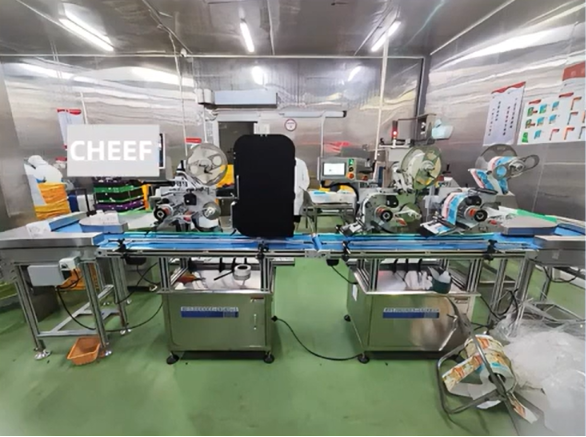
Technical Architecture & Hybrid Head Configuration
The engineering value of the CF-DT01P lies in its modular hybrid configuration. It can be configured as a 3-head or 4-head line depending on production needs. This architecture bridges the gap between dynamic, on-demand printing and high-velocity pre-printed label application.
Station 1: Synchronized Real-Time Print & Apply
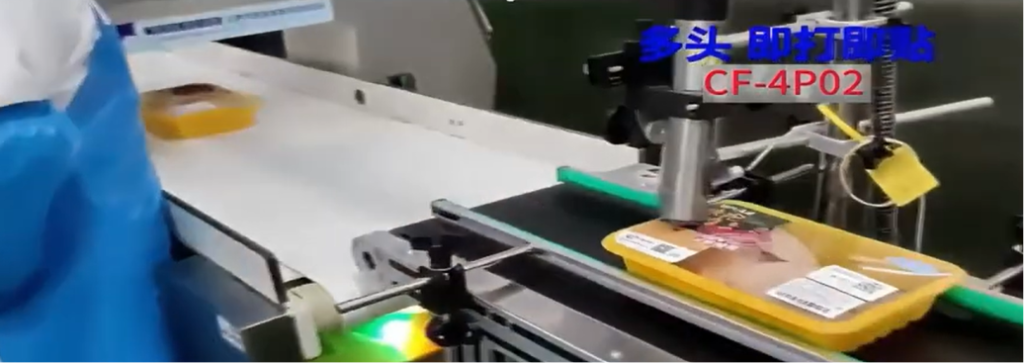
The primary station functions as a complete real-time print-and-apply engine equipped with an integrated thermal transfer coder. When a product trips the inline photoelectric sensor, the print engine instantly renders variable, customized data onto blank or partially pre-printed media before applying it to the substrate. This ensures complete data serialization without slowing down the line.
Stations 2, 3, & 4: Multi-Zone Pre-Printed Applicators
The downstream stations consist of dedicated, high-speed label application heads. These units are engineered to apply high-finish graphics, logos, color codes, or regional compliance stickers. They can apply labels flat, at specific angles, or tilted relative to the moving package, giving plant engineers a high degree of placement flexibility.
Integrated Spacing Control & Closed-Loop Servo Drives
To apply up to four unique labels on a single target without collision or skewing, the CF-DT01P features an intelligent automatic product pitch spacing mechanism. Incoming packages are automatically gapped and arranged with exact physical spacing before they reach the first labeling zone.
The entire transport and dispensing system relies on closed-loop servo control. This setup provides micro-second feedback adjustments to keep label placement perfectly synchronized with conveyor velocity, even during rapid acceleration or deceleration.
Technical Capabilities & Performance Matrix
| System Component | Functional Specifications | Industrial Advantage |
| Control System | Multi-axis Closed-loop Servo Drive | Eliminates tracking errors; ensures stable, highly repeatable dispensing cycles. |
| Label Placement Precision | High-accuracy mechanical alignment ($\pm 1.0\text{ mm}$) | Meets strict pharmaceutical and medical device tracking standards. |
| Throughput Speed | Variable speed matching up to 45+ meters/min | Scales to match high-volume filling, cartoning, or pouching lines. |
| Print Head Technology | Inline Thermal Transfer Coding Engine | Delivers crisp 300 DPI text, graphics, and 1D/2D data matrix codes. |
| Supported Formats | Multi-label composite arrays (Up to 4 Heads) | Allows synchronous application of branding, regulatory, and variable tracking labels. |
Industry-Specific Applications
The modular design of the CF-DT01P makes it well-suited for several highly regulated, high-volume industries:
- Pharmaceutical & Medical Devices: Ideal for labeling medical kits or physical therapy components. It applies multi-layer warning graphics, brand logos, and real-time serialized UDI (Unique Device Identification) data on a single line.
- Daily Chemical & Cosmetics: Perfect for flat-surface bottles, air cushion cases, and structured cosmetic pouches that require a primary decorative face label alongside dynamic batch codes, ingredient updates, and regional shipping data.
- Advanced Fulfillment & Logistics: Streamlines high-speed fulfillment workflows by applying standard marketing materials and variable shipping info to flat-pack boxes or automated air-cushioned poly mailers in one continuous process.
Proactive Maintenance & Systematic Troubleshooting
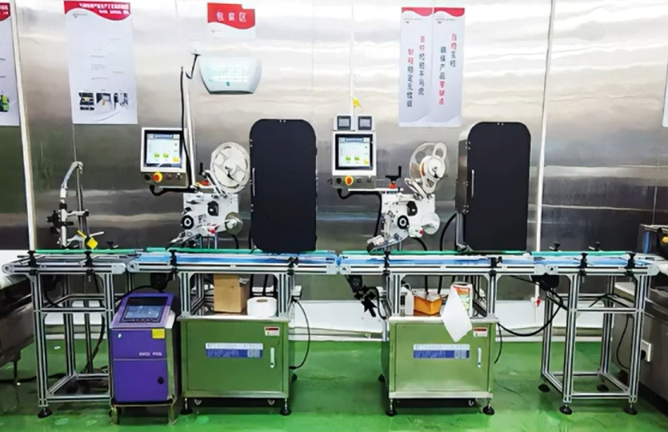
Because a multi-head machine controls multiple critical points along the line, proper preventative maintenance is key to maximizing Overall Equipment Effectiveness (OEE) and protecting printheads and sensors.
Preventative Maintenance Protocol
- Daily Optical Sensor Sweeps: Clean all photoelectric product detection eyes and label gap sensors with compressed air. Because multi-head configurations use multiple cascading sensors to manage product spacing, even minor dust buildup can disrupt the timing sequence.
- Printhead Care: Wipe down the Station 1 thermal printhead daily using 99% isopropyl alcohol wipes. This removes accumulated ribbon wax and paper dust, preventing pixel dropouts and extending printhead life.
- Adhesive Stripping on Drive Rollers: Inspect the servo-driven pull rollers weekly. Strip away any residual adhesive using a specialized release solvent to prevent label slippage and maintain consistent placement accuracy.
Troubleshooting Technical Faults
- Symptom: Product Spacing Desynchronization
- Root Cause: The entry-level automatic pacing mechanism or timing belts are slipping, or the product sensor is picking up false reflections from glossy packaging surfaces.
- Remedy: Clean the spacing belt drives and check their tension. If you are running highly reflective plastic or foil pouches, adjust the photoelectric eye’s gain threshold or switch to a polarized retro-reflective sensor to eliminate false triggers.
- Symptom: Downstream Labels Overlapping or Out of Alignment
- Root Cause: Accumulation of tolerance errors across multiple heads due to loose mechanical locks on the applicator mounting brackets.
- Remedy: Re-verify the physical alignment of each applicator head relative to the conveyor axis. Tighten the locking levers on the multi-axis adjustment columns and use the HMI panel to fine-tune the electronic delay timers (measured in milliseconds) for each station.
- Symptom: Ribbon Wrinkling or Legibility Loss on Station 1
- Root Cause: Unbalanced printhead pressure or unequal tension between the ribbon supply and take-up spindles.
- Remedy: Adjust the manual pressure knobs on the print mechanism to distribute force evenly across the label width. Ensure the ribbon material matches your specific label media (e.g., full resin ribbons paired with synthetic matte labels).
Strategic Advantages for System Integrators and Distributors
For automation distributors and plant engineering leads, the CF-DT01P offers distinct operational advantages:
- Space Optimization: Consolidating up to four labeling operations onto a single compact chassis saves valuable floor space, making it easier to integrate into tight, existing factory layouts.
- Simplified Data Integration: Instead of interfacing with four separate control systems, system engineers connect to a single central control unit. This vastly simplifies upstream PLC communications via standard industrial protocols.
- Flexible Scaling: The hybrid design allows users to swap or reconfigure individual heads as packaging layouts evolve, protecting their capital investment over a longer operational lifespan.
Frequently Asked Questions (FAQ)
1. What happens if one of the downstream label rolls runs out of stock?
The CF-DT01P can be equipped with an optional smart sensor package that detects when a label roll is empty or broken. When triggered, it sends an early warning signal to the operator or pauses the conveyor line via an interlock circuit, preventing unlabelled products from moving down the line.
2. Can individual heads apply labels to different sides of a package?
The standard CF-DT01P configuration is engineered for flat, top-surface, or slightly angled/tilted application on flat items like boxes or bags. For complex multi-sided application (such as simultaneous top and bottom labeling), the machine can be customized with specialized mounting brackets or dual-conveyor split lines.
3. What is the maximum label size the applicator heads can handle?
The applicator heads support standard industrial labels up to 100 mm or 150 mm in width, depending on the chosen model variant. They can handle label lengths up to 300 mm, covering a wide range of packaging shapes and sizes.
4. How long does it take to switch over between different product sizes?
Because the machine uses full servo control and features calibrated hand-cranks on its mounting columns, physical changeovers typically take under ten minutes. Operators select the new product recipe on the HMI touchscreen to update the electronic timing delays, and then adjust the mechanical guide rails and applicator heights to match the new container dimensions.
Watch the Full Video Tutorial:
This article summarizes the key points from our original video. Watching the full tutorial provides a clearer understanding of the procedures, demonstrations, and practical maintenance tips.
▶ Watch the full video below.
📺 Subscribe to the Cheef YouTube Channel to receive future maintenance guides, troubleshooting tutorials, product demonstrations, and industry updates.
